







Once we attain a vision of higher knowledge, the entire arena within which the previous concept of our personal identity was valid is transcended and dissolved. This is why the poet Kabir said that on the path to the absolute, there is only room for one. We can never know the highest truth. The wave cannot feel its own wetness. The tongue cannot taste itself. Only essence can perceive essence. The parts of us that are seeking higher knowledge are negated and dissolved by the light of that knowledge. As Augustine so beautifully declared, "The eye through which I see God is the same eye through which God sees me."
Perhaps there is a place within ourselves that has access to the full realm of the nature of all existence, unabridged and uncompromised. But if that true apex of our being is ever attained and experienced in its absolute fullness, there will be no ego, no brain, no mind, and no physical body left to write about it.
Saints and sages of all traditions have nevertheless insisted that deeper knowledge is worth striving for. Growth is inherent in our nature. We are explorers, frontiersmen, philosophers, and scientists. We are moved to grow and evolve and view increasingly complex systems of knowledge, to discover more and more information through which to look at and evaluate our world. That is just what we do.
The scriptures of India explain that Supreme Consciousness is composed of two qualities, called prakasha and vimarsha. Prakasha is the energetic light and power that manifests as this entire creation. Vimarsha is the self-awareness that perceives that light. Although we appear to be separate from the worlds around us, in our deepest essence we are both the creative light and the awareness that perceives the light; we are artist and audience at once. In this space, we can taste the oneness of all creation. In fact, the act of perception is considered an act of creation as well. To examine this idea, one need only look at our own dream state. When we watch a dream, are we perceiving or creating? Are we the subject or object, the creative light or the self-awareness that perceives its dance?
Spiritual evolution is kind of like a game, a scavenger hunt. It is our nature, indeed one of our purposes for being here, to become more and more self aware -- with the self continuously expanding until it eventually, one day, become established in the awareness of our total and complete oneness with this entire creation. The prize. Paradoxically, we are already One even when we don't know it. This journey of conscious evolution is a topsy-turvy game.
But fortunately, there are perks. We are following the road back to our true nature. And as with any other behavior that nature wants to positively reinforce, such as procreation and ingestion of foods, there is a pleasure, but this time it is a higher blissful space that we enter as our worldview expands to include more and more Truth.
You ask, "How can we know the Infinite?"
I answer, not by reason.
It is the office of reason to distinguish and define.
The Infinite, therefore, cannot be ranked among its objects.
You can only apprehend the Infinite by a faculty superior to reason,
by entering into a state in which you are your finite self no longer,
in which the Divine Essence is communicated to you.
This is Ecstasy.
It is the liberation of your mind from its finite consciousness.
-- Plotinus
The process of growing past our previous levels of understanding brings pleasant, even ecstatic side effects, along with the shock and despair that can come initially as our concepts are shattered and proved untrue. Then there are those precious moments when we can free ourselves of all the levels of knowledge, and simply rest, cradled in the undifferentiated field of awareness, with no thoughts, no judgments -- just the blissful throb of supreme Consciousness.
This is perhaps the greatest gift of life available to us, and even more amazing, it is our birthright. We can expand our awareness until we too are both imminent and transcendent. We can dance in that oneness, learning and growing, making mistakes and achieving successes, even while we watch from a higher space. We have written, produced and directed our own drama, and we also act in this play. Yet, we are also the audience, enjoying the trials, tribulations and discoveries of our character, displayed upon the screen of consciousness. The I, then, is truly a We. And conversely, that which we thought of as We becomes I. Duality dissolves. Opposites coexist. We are awake and asleep at the same time. What an amazing creation.
We are born with an infant's egocentric predisposition to experience the world completely in relation to our personal needs and desires. Some manage to hold on to this un-tempered form of egocentrism beyond their childhood years. These are the people we call selfish or narcissistic, whose only way to translate events of the world around them is through the impact of these events on their own personal life and well being. If you see the oneness of all creation, then being narcissistic isn't so bad, because you are simply relishing in That which is all.
This loosening of the egocentricity's hold is a central tenet to many of the most advanced and ancient spiritual traditions. Over and over again, the great teachings extol us to be detached from petty desires, to become free from the bondage of ego, to love our neighbors as ourselves, to serve selflessly, and to act without attachment to the fruits of our actions.
Wake up O man, at least now wake up, o foolish one.
Consider this whole creation as a mere dream.
This world is like a flower in bloom;
as you watch it, it wilts right before your eyes.
So why are you attached to it?
-- Brahmananda, an Indian poet saint
Creation and perception of creation co-exist as one manifestation. It is the gravity pull of egocentrism that keeps our cycles small -- just as the planets can never move from their orbits as long as the gravity of the sun pulls on them, keeps them close, and binds them to move through the same cycle of space over and over again, instead of allowing them to break free and move through other galaxies, other universes.
It can be difficult to let go of our favorite concepts, even the ones that ultimately lead to pain and limitation. These beliefs are comfortable comrades, closer to us than even our families and friends. In fact, one might say that our beliefs are us -- they make us unique individuals.
Have you ever tried to kick a habit? It can be difficult to do. Even when people know something is bad for them, they will still do it, pulled by the force of habit. Imagine how strong our habit of identifying as a separate individual must be, this deluding wine of egocentricity. It could take a whole lot more than twelve steps to give that one up!
Now for the list of possible side effects from this process of conscious evolution. En route to the bliss and freedom of liberation, we may feel a loss of identity as we open up to the universal wholeness. The drop is about to merge into the sea; the sea is giving up its small identity as it flows into the ocean. Yet, there is also great camaraderie in realizing that we are an integral part of the universe, the earth, and society -- much as the ant building an anthill is part of the consciousness of the entire group of ants. No one ant is able to see the whole picture, yet each is moved by an underground stream of natural guidance and intelligence that feeds and moves them to work in blind but organized unison with the group -- according to a master plan no individual ant can see.
We are the same way, and like the ants, we too do not appreciate the depth of this great guiding force. In fact, when guided by this universal intelligence, we will often create any passable excuse for why we did what we did, unless we're a teenager, in which case we'll probably just say, "I don't know." Adults look upon these words as a sign of defiance or ignorance, when the phrase may in fact be a sign of an evolved soul who knows they are guided by unknown forces bubbling up from the subconscious mind, and perhaps even coming from other levels of beings that may live in dimensions intersecting with ours.
As the process of conscious evolution progresses, we may also experience a lack of motivation, as society's most highly acclaimed goals show themselves as ephemeral fantasies. In fact, two of the top-ten signs of success in our culture are exactly the two things Indian saint Ramakrishna declared to be the two most potentially destructive vices to the evolving soul: money and women (which could be made politically correct by understanding the forces behind what these words represent -- lust and greed).
As we become more attuned to the path of spiritual evolution, many vices and limited goals will begin to fade, leaving us feeling a bit lost at times. During these times, it would be fortunate to be in company with others on whatever kind of path resonates with you, as long as it is a path that ultimately leads to freedom from the path. After awakening to higher knowledge, I was blessed with the ten wonderful years in an Indian ashram under the guidance of two colorful and powerful spiritual teachers. I was surrounded with elevated teachings all day long, and so did not fall into fear or despair about having left my previous goals behind to focus on spiritual growth.
As our maps are updated, piles of crumbling concepts can leave us in a space of vulnerability and confusion, even emptiness. This is why many scriptures say it is so essential to have a guru on the path, a spiritual guide who has traveled the terrain and can give suggestions, guidance, and if need be, commands.
Though we may live on a superficial, limited level of sensory-based experience, our roots go deep into the most profound and fertile soil of being. That perfect oneness is always there, and it always moves through us, as us. However, until we break free of egocentricity, our own habits of limited thinking will prevent us from experiencing the full nourishment of the roots of our own great being. As my guru used to say, this is a path of "getting rid of what you haven't got."
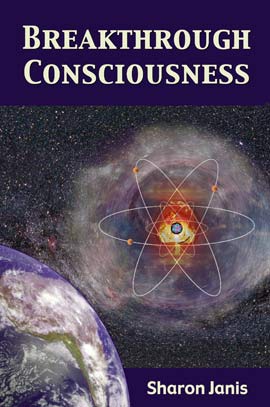
CLICK HERE to go to the Table of Contents of
Breakthrough Consciousness

Additional Works by Sharon Janis
Click on a book or audio CD to enjoy it online
as part of the Night Lotus offering of free multimedia spiritual resources

View our videos on:






CLICK HERE to go to Sharon's speaking, concerts, and workshops page
Visit the Night Lotus website of free multimedia spiritual resources
Home Page | Contact | Site Map | Books | Spiritual Commentary Blog | Secrets of Spiritual Happiness | Links | Chanting and Devotional Singing | Inspiring Videos | Sanskrit Spiritual Scriptures | Workshops | Photographs | Kirtan Chanting | Chai | Sacred Music Concerts | About the Artist | Disclaimer | About Night Lotus | Purchasing Our Works | Gifts for You